

The Good Parent
On Practical Wisdom as the Art of Excellence

Thank you for coming back, or for finding your way here for the first time. However you arrived—I’m so glad you’re here.
“For the man who is truly good and wise bears all the chances life becomingly and always makes the best of circumstances, as a good shoemaker makes the best shoes out of the leather that is given him.”
Aristotle, Nicomachean Ethics I.10
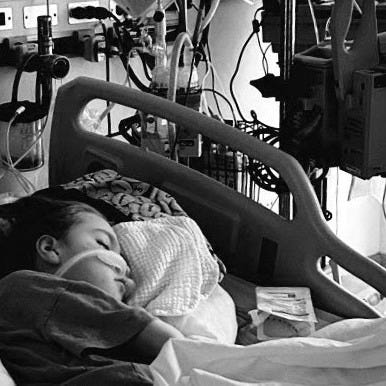
The alarm goes off at 2:47 AM.
Not the clock but the pulse oximeter, which is a different animal entirely. My wife and I are moving before we are awake, a choreography so practiced that our bodies have memorized it faster than our minds have. Check the probe. Check her color. Check the rise and fall of her chest against the ventilator’s steady rhythm. The Kartoffel is fine. It was a positional issue and the probe shifted on her toe. We resettle her. We resettle ourselves. The monitors quiet. The house resumes its mechanical breathing.
We lie back down. Neither of us sleeps.
In the dark, I find myself doing what I often do after the adrenaline has no more work to do: I begin to think through the night’s decisions. Did we make the right call? Should I have checked her temperature as well? What if it wasn’t just the probe? Was I too slow, or was I, in fact, exactly the right speed? This is not anxiety, or not only anxiety, but something more deliberate. It is a practice I did not choose so much as grow into, the same way a callous forms, not by decision but by repeated contact with rough material.
The ancient Greeks had a word for this practice. They called it phronesis. We translate it, a little flatly, as “practical wisdom” or “prudence,” though the philosopher Aristotle meant something far richer. For him it is the cultivated ability to perceive what a situation actually requires, and to act accordingly; not from rule, not from habit alone, but from a deep, seasoned attentiveness to the specific gravity of this moment, with this child, in this particular kind of dark.
If you are a parent of a medically complex child, you are already practicing phronesis. You may not have a name for it. But you know it in your hands.
Practical wisdom is not expertise in the clinical sense, though it can include clinical knowledge. You may have learned about the half-life of the rescue medication, the therapeutic index for various seizure meds, or the subtle differences between voltage-gated sodium or voltage-dependent potassium channelopathies. That knowledge is often necessary and always hard-won. But it is knowledge of universal facts that hold steady regardless of circumstance. Phronesis is different. It operates in the territory that textbooks cannot reach, the territory of particulars. Particulars like the specific quality of the cry that precedes a tonic-clonic, or the three-second window before a coughing fit becomes a desaturation.
Emma does not seize the way much of literature describes. She does not pale before, she flushes first and pales after. She does not stiffen first; she goes quiet. The monitors may say she is stable when, if you know her, you can see she is not by the particular set of her jaw, the way her hands rest differently when something is building. This is not instinct, though it can look like instinct from the outside. It is the accumulated, deliberate act of paying attention over time. It is the eye of experience. And it is, in the fullest sense, a form of practical wisdom.
The practically wise parent recognizes that no protocol covers every situation because luck, that raw, indifferent variability of her condition, regularly produces situations for which there is no protocol. Phronesis is what you exercise in the gap between the protocol and the moment. It is the ability to deliberate well under pressure, to hold two or three possible courses of action, weigh them against the specific texture of right now, and move. Not perfectly. But well enough. And then, afterward, in the dark, to review your actions. Not to punish yourself, but to refine.
This is how practical wisdom grows. It is not given. It is made, in the repetition of hard nights.
There is a version of parenting advice that implies good parents are simply people with good intentions and warm hearts. This is not wrong, exactly, but I think it is insufficient. As they say, a sharp tool in untrained hands is a liability. Likewise, intention without discernment can cause harm in the most sensitive places such as the exam room, the IEP meeting, in the 2:47 AM alarm.
Our situation and things in it are akin to tools. Wealth, strength, access, opportunity. All of these are not good in themselves. They are instruments. A hammer in the hands of someone who does not know what they are building is just a thing that damages whatever it touches. But in the hands of a craftsperson, it builds something that lasts.
The same is true of everything that comes to us by luck; including the good luck of having a strong advocate for a partner, a generous specialist, a good insurance year, a smooth stretch of weeks. These things are genuinely good. But they do not automatically make you a good parent. Practical wisdom is what converts good fortune into good action. It is the skill that looks at a stable week and asks, ‘What do I do with this?’ Do we push for the therapy evaluation we have been delaying? Do we rest, because rest itself is preparation? Do we make the phone call we have been dreading?
The prudent parent is not simply reactive, they are responsive. Reactivity is your nervous system’s answer to a crisis. Responsiveness is your character’s answer to a life. One is automatic. The other is cultivated.
There is an analogy, again borrowed from Aristotle, that helps illustrate what this looks like. A good shoemaker makes the best shoe possible from the leather available. Not the shoe they wished they had leather for. Not the shoe they could make if the leather were different. The best shoe from this leather, right now. A good parent makes the best of the circumstances they have. Perhaps that includes working to improve those circumstances, but it is not a life spent fantasizing about what they wish they had.
This is the practical wisdom available to us. Not the wisdom of better circumstances, but the wisdom fitted to these ones. The ‘leather’ of our situations—the diagnosis, the prognosis, the limitations of a body that requires extraordinary maintenance—are often poor by any conventional measure. And what’s more it is housed in systems that regularly treats our children as line items. The relentless, compounding fatigue that makes every decision feel weightier than it should. And yet, something is still being made from this. I see it when my wife navigates a prior authorization call with a patience that has iron in it. A patience deliberately chosen because she has learned that fury spent carelessly accomplishes nothing for Emma, while fury channeled into clear, firm, documented language sometimes opens a door. That is phronesis. That is a shoe being made from difficult leather.
I see it in the 2:47 AM deliberation. In the instinct that is not quite instinct, the fast, practiced assessment that looks effortless only because it has been done hundreds of times and each time, slightly refined. I see it in the ability to hold open the question what does she need right now. Not what does the monitor say, not what does the protocol dictate, but what does she need, now, from us, and to answer it well, or well enough.
There is one more thing worth naming, because it surprised me when I came to understand it. Practical wisdom does not eliminate bad luck. It does not, in the final accounting, protect Emma from the facts of her condition. What it does is reduce the surface area where bad luck can do additional damage. The practically wise parent is harder to catch off guard. Not because they are unfeeling, but because they have done the ongoing work of attending to their child, to their own responses, to the difference between what they can control and what they cannot. They carry what they are choosing to carry. But they carry it with technique.
You are already doing this. In ways you probably do not credit yourself for, in the middle of the night and in the fluorescent offices and in the ordinary hour when you look at your child and know—just know—what they need before they can ask.
That knowledge is not nothing. It is, in fact, everything. It is the good shoemaker’s art. The art of the excellent parent. The Good Parent.
And it belongs to you.
Phronesis is not a skill you acquire and then possess, you cannot develop it by reading about it. It is a practice which means it requires a repeatable form. Over time, I have come to rely on three questions I return to when the situation is unclear, the stakes are high, or I have just acted and am lying in the dark wondering if I acted well.
The first is: What does this moment actually require?
Not what do I fear, not what does the protocol say, not what did I do last time. What does this child, this hour, this specific circumstance actually require of me right now? This question slows the reactive nervous system just long enough for the responsive character to engage. It is the perceptual move that phronesis begins with: seeing clearly before acting.
The second is: What is the best I can do with what I have?
This is the shoemaker’s question. It releases you from the fantasy of better leather, the better diagnosis, the better system, the better version of yourself who got more sleep. It returns you to the only territory where excellence is actually possible which is here, now, with these resources, these constraints, this child. It is a question of radical presence. And it is, in my experience, the one that most reliably converts frustration into action.
The third is: What will I do differently next time?
Not what did I do wrong. That framing leads to punishment, not refinement. What will I do differently. This is the 2:47 AM question, the one I ask in the dark after the adrenaline has no more work to do. It is how the callous forms. It is how the instinct that isn’t quite instinct gets built, slowly, out of repetition and honest attention.
You don’t need to ask all three in sequence. Some moments only call for one but they are portable enough to carry each at all times. They fit in the exam room, the insurance call, the ordinary hour when you look at your child and feel the full gravity of what is being asked of you.
This is not a fix. These questions won’t lift you out of crises. But they will help you carry your burden with technique. And technique, over time, becomes something very close to wisdom.
Until next time, stay safe, stay kind, and know that you are appreciated.
Cheers,
[kartoffelvater]
Did this newsletter resonate with you? Reply with your thoughts or share your own story. And if you know someone who might need these words today, please forward this along.
We wouldn’t be here without you. Every bit of support helps and we appreciate it more than words can say!
I hope you enjoyed this post. Don’t forget to check out the original article over at The Courageous Parents Network, a fantastic resource for exploring the world of raising children with disabilities and rare genetic disorders. Be sure to visit their site for more insights!
Thank you, Bud. Several of the points you've raised have been coalescing in my mind - particularly around a choosing not to engage with blame and rage, so this resonated deeply: "The relentless, compounding fatigue that makes every decision feel weightier than it should. And yet, something is still being made from this. I see it when my wife navigates a prior authorization call with a patience that has iron in it. A patience deliberately chosen because she has learned that fury spent carelessly accomplishes nothing for Emma, while fury channeled into clear, firm, documented language sometimes opens a door. That is phronesis. That is a shoe being made from difficult leather."
There's something here too about the compounding weight, that hones and sharpens our edge and points us to act more precisely - because we're more acutely aware of time, and finite energy; targeted, efficient impact becomes more essential.
Spookily, but not surprisingly, this echoes some of my own actions over the last few weeks, and what I was drafting today.
Phronesis as a practice seems like the 'door-jam' that creates/opens the space Frankl highlighted between stimulus and response. I used to wonder how anyone could catch themselves in the moment, create that space, and make that discerning choice. Perhaps, as caregivers, the phronesis is the front part of the care, before the giving can be chosen.
Love those 3 questions. I think they're part of my ingrained auto-cue but also speak to the MacGyvering we do. Really good article, Bud.